Showing posts with label Graffiti. Show all posts

Monday, August 25, 2014

Only in New York--A Photo Essay

On a recent visit to Manhattan I wandered around like the tourist that I am, clutching my camera to record sights and sites that native New Yorkers don't even notice as they hurry about their daily chores.  Nothing startles New Yorkers, whether it's break dancers on the subway, dog-sized rats in Central Park or naked cowboys and cowgirls in Times Square, but I, accustomed to life in a quiet New England village, kept on snapping photos and muttering, "Only in New York!"
Where else can you enjoy the sunset and dinner on your roof, 27 stories above the pavement...

....or eat on a barge in the Hudson River that never leaves the dock. (It's called The Frying Pan, at 26th Street and the Hudson.)
....or you can just have organic hamburgers delivered from the nearest Bareburger.
Granddaughter Amalia samples all the free fun in Manhattan's parks and playgrounds.  Here she is driving a train at the Little Engine Playground at Riverside Drive and West 67th Street. (And afterwards we always walk over to "Pier i"  for outdoor dining on the water.)
 She's tried fishing at the Harlem Meer in Central Park on the East Side at 109th Street. (It's all catch and release and you can rent the fishing poles and get instructions and free bait.)
And in the summer heat, nearly every playground in Manhattan has sprinklers and various kinds of water play.
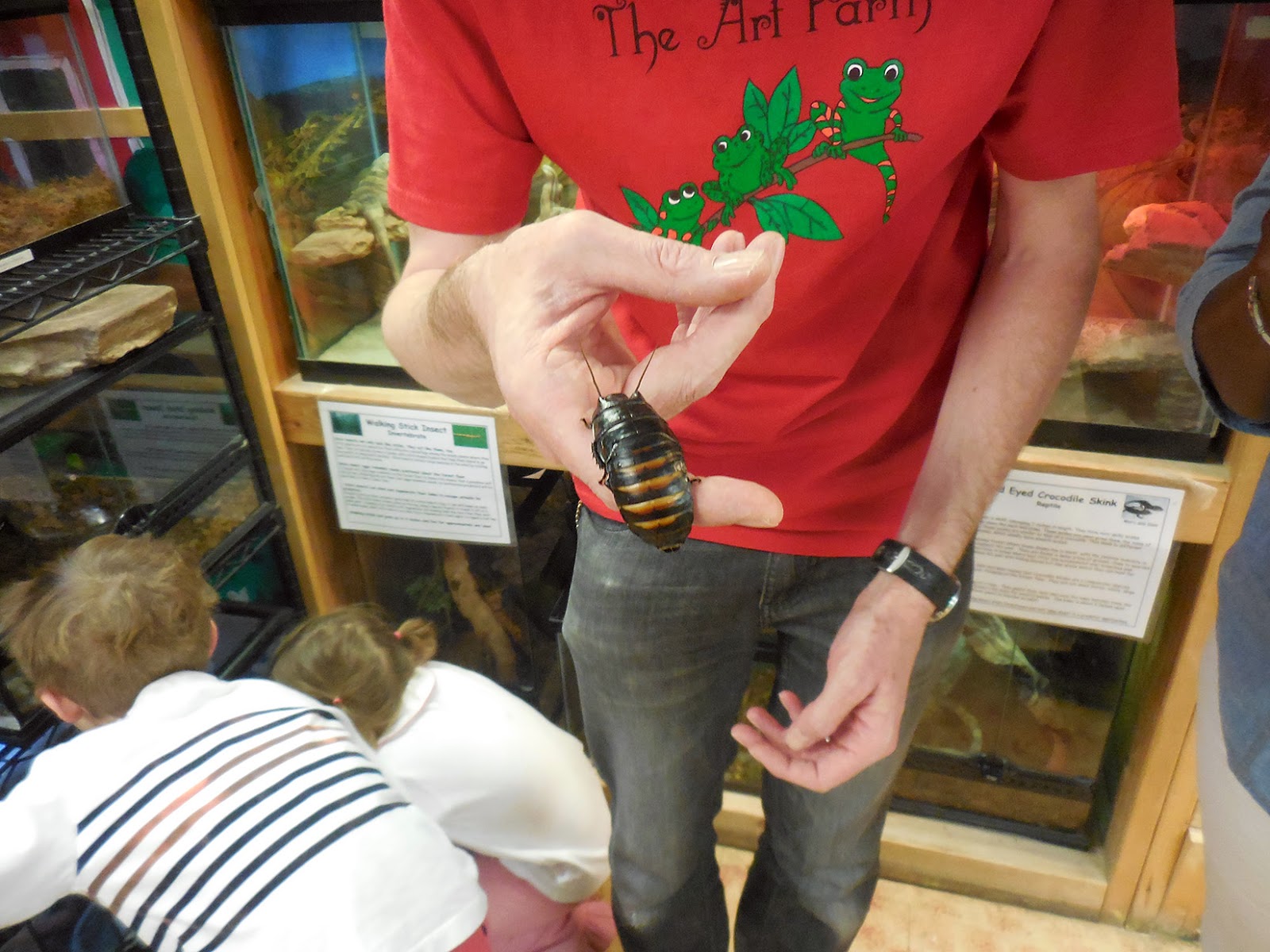
On my recent visit, Amalia and I went to Art Farm at East 91st Street between York and First where  children learn about nature, animals and how to care for the planet.   Where else would you meet a giant Madagascar Hissing Cockroach?
Some of the children were willing to touch the creature, but most of the adults retreated to watch from a distance.
Amalia was more eager to pet the rabbits, hens and a new little guinea pig.
Wandering around by myself, I  noticed near Times Square one of the soon-to-be illegal Elmos who harass tourists and ask for money.
I marveled at the ever-present dog walkers.  How do they keep all those dogs from fighting with each other?  Or breaking away from the pack?
And I noticed this truck delivering Cannabis Energy Drink to the local Korean Deli.  I wonder what they put in that drink?

Art is everywhere in Manhattan, and most people never even notice it.
I spied faces in the architecture
Fire escape shadows on uninhabited buildings...
Split-Rocker is a giant flower-covered sculpture by Jeff Koons which dominates Rockefeller Plaza and coincides with the blockbuster Koons show at the Whitney Museum.
Even this graffiti-covered truck, which we encountered as we drove toward the Triboro Bridge on our way home, qualifies as art in my opinion...one of the many odd treasures you can find only in New York, the greatest city in the world.

Monday, February 22, 2010

More on Oaxaca, Mexico and Art on the Street


(Please click on the photos to enlarge)

Here are the photos of the art on the walls of a small restaurant in Oaxaca Mexico called (I think) Nuovo Babel. I really like the sort of magical realism and graffiti/street art quality of these paintings and I'm sorry I couldn't read the name of the artist in the signature. I thought the wall of men in masks were meant to be superheroes, but the teacher in our art course, Mari Seder, tells me these are members of "Lucha Libre" a violent kind of masked wrestlers very popular in Mexico.

By the way, the title of the masked men painting is "odios" which I'm told means "hatred."

I can't get over how often the skeleton and the skull appear in contemporary Mexican art and folk art. The Mexicans have a completely different attitude toward death than North Americans. It's an accepted part of life--not to be feared. I think the skull on the mariposa (butterfly) indicates that death is just another phase of life, like the transformation of the caterpillar into the butterfly.

I am also posting four last photos that I took before leaving Oaxaca. These are all taken in the immediate vicinity of the beautiful church of Santo Domingo, near the studio where we spent most days of our art class (sponsored by the Worcester Art Museum.) In the last photo --taken to illustrate the amazing colors that you find everywhere in Mexico--the figures are our two instructors, Mari Seder and Humberto Batista, and one of our fellow students, looking into one of the shops on the side of Santo Domingo.

My next post will be about "Life, Death and Carnival in Puebla".

Saturday, February 20, 2010

Art and Graffiti in Oaxaca, Mexico


(Please click on the photos to enlarge them.)

In Oaxaca, art is everywhere, from the works of local artists like Francesco Toledo, hanging in galleries and museums, to the embroidery on the traditional trajes (costumes) worn by women in places like Tehuantepec and sold for hundreds of dollars in the shops here.

The people of Oaxaca seem to create art instinctively, even when choosing to paint their houses and doorways in startling colors with a sophistication that never ceases to amaze me. A mask hanging on a wall near the door to a latrine, or signs glued to a wall, constantly make me stop and stare. An orange doorway becomes abstract art worthy of Mondrian. The sign about the ¨Ninos¨advertises that the store is a place to dress your Child of God. These Christ Child dolls which sit on the family altar, evidently need to get a new set of clothes and to be blessed in the church before Lent begins (last Tuesday) which is why I have seen so many people carrying their Christ Child dolls lately.

I’m presently in Oaxaca taking an art class sponsored by the Worcester Art Museum and led by photographer Mari Seder and artist Humberto Batista. They are teaching us the art of collage. Above is a photo of the first one I tried in its UNFINISHED state. I incorporated photos I took of Mexican church statues and photos taken by daughter Eleni Gage and myself of women encountered in various parts of Mexico. Most of them were selling their traditional art — embroidery, bracelets, necklaces, weaving. We always asked their permission before taking their portraits. I’m calling this collage “Our Lady of the Sorrows” because these women all seem sad or reflective.

I’m also posting some photos of the graffiti that you see everywhere in Oaxaca. The people who own these buildings consider the graffiti destructive and a terrific nuisance, but I can’t help thinking it’s another kind of striking Oaxacan art. One row of the photos above shows graffiti art taken indoors to decorate a small restaurant called Nuevo Babel. (Whoops--I just realized I didn´t download that series of photos to this Mexican computer--will use it in a posting tomorrow.) I’m sure much of the street art is politically motivated, inspired by the riots here four years ago and government corruption and oppression, but as an outsider, I enjoy it as art without understanding the underlying political message, if there is one.

Last night, Friday, we were privileged to see more local art in the costumes and traditional dances of the seven different regions of the state of Oaxaca, presented at the beautiful Camino Real Hotel in a buffet and dance spectacle held in the former convent’s chapel. The men are wearing costumes of the Dance of the Feather, which symbolizes the Mixtec-Zapotec fight against the Spaniards. The women in the black embroidered costumes come from the Isthmus, where women rule in a matriarchal society. Their dance celebrates the gathering of turtle eggs (with erotic undercurrents.) Each of the seven regions of the state of Oaxaca have their own embroidered costume and dance. In two of the regions, the women dance slowly, looking grimly down at the floor. But not the women of the Isthmus!

It’s going to be hard to leave the colors, flowers and art found everywhere in Oaxaca to go back to the snow of Massachusetts.