Showing posts with label Worcester Historical Museum. Show all posts

Wednesday, November 18, 2020


My Dinner at the White House
Reposted

2016-03-08-1457473356-4506980-smallGagesReagansNelliganPayton.jpg
My mother always pointed to Nancy Reagan as the ultimate Lady, one who knew exactly how a lady should behave and never raised her voice or appeared inappropriately dressed. Sadly, my mother passed away in January of 1985 (of congestive heart failure, the same thing that took the former First Lady Nancy last Sunday) so she never got to hear about our first meeting with President Reagan and Nancy in October of 1985 and our second one—at a White House state dinner—the following March.

It was the Reagans’ U.S. Ambassador in Charge of Protocol, Selwa “Lucky” Roosevelt, who introduced us to the Reagans after Nick’s book Eleni was published in 1984—about the life and death of his mother during the Greek civil war. Eleni was tried and executed by Communist guerrillas because she had organized the escape of her children from their mountain village. In 1985 Eleni became a film starring Kate Nelligan as Nick’s mother and John Malkovich as the adult version of Nick, who, while a foreign correspondent for The New York Times, researched the details of her death.

Lucky Roosevelt gave a signed copy of Eleni to the Reagans, who both said in interviews that it was the best book they read that year. They also enjoyed the film. In October of 1985, Lucky invited us to a glamorous dinner party given by her and her husband, Archie Roosevelt, a grandson of Theodore. The guest list included actress Glenn Close, author Jerzy Kosinski, and Abe Rosenthal, the editor of The New York Times. I could not tell you what we ate, but here are some things I remember from that party: Lucky had to install $10,000 worth of new draperies in her house to satisfy the security people. On the night of the dinner, her street in Georgetown was closed, and behind every heavily draped window stood an armed guard. Nick and I both sat at the President’s table where he regaled everyone with anecdotes and funny stories filled with details—facts and figures rolled effortlessly off his tongue.

One thing I remember is that, between the main course and dessert, the First Lady took out a compact to re-apply her lipstick. This was something that my late mother had insisted was not proper behavior, so I sent a silent mental telegram to heaven, telling her, “If Nancy Reagan can do it, then I can do it.”

As the dinner ended, both tables of guests moved toward the living room. I found myself walking beside the First Lady and I exclaimed to her “He’s such a marvelous story teller!”

I quickly forgot my comment, but Nancy remembered it, because she noticed and remembered every detail and everything that anyone said.

A few months later, early in 1986, Nick and I received an invitation to a state dinner at the White House to be given by the Reagans on March 18 “on the occasion of the visit of the Prime Minister of Canada (Brian) Mulroney and Mrs Mulroney.” I began an arduous search for a dress and, with Nick’s help, I settled on one with a long black skirt and a pleated white bodice, folded like a fan. We discovered it at a store called Sumiko, in Framingham, MA. It cost $700.00--more than my wedding dress--but Nick loved it and insisted I buy it.

On March 18, 1986, in Washington, we inched forward to the White House door in a rented limousine and finally were welcomed by military aides who checked our passports. We were led down a long hall and into a room where the roped-off press waited and our names were announced. The aide with the microphone whispered to me “I like your dress”. I was in heaven. At the top of a staircase, aides handed us our table assignments. Nick was at table nine, I was at 11. Little did I know what a significant number it was.

The U. S. Marine Orchestra serenaded us to the East Room, decorated with white tulips and flowering cherry trees strung with tiny white lights. We began to recognize celebrities, including ballerina Cynthia Gregory, Fiat chairman Gianni Agnelli, columnist William F. Buckley and Prince Karim Aga Khan with Princess Salimah Aga Khan, who was wearing a double row of diamonds interspersed with emeralds as big as marbles.

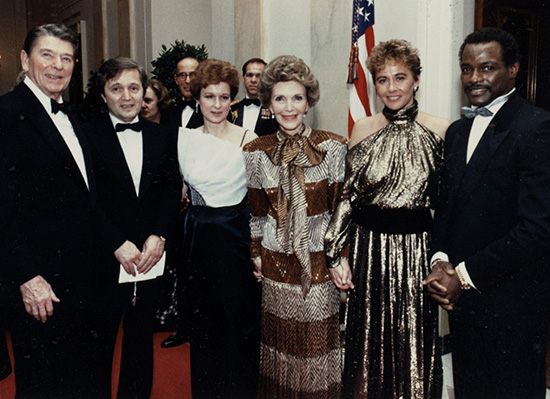
The orchestra broke into “Ruffles and Flourishes” as a voice announced the Reagans and the Mulroneys. The first lady was wearing a floor-length Galanos gown in wide horizontal stripes of sparkling gold and silver.

They formed a receiving line which we were directed through, husbands first. (Unattended ladies, like Kate Nelligan that night, were provided with a military escort.) Then we headed toward the State Dining Room with tables decked with gold candlesticks, gold flatware and gold bowls of red and white tulips. And of course Nancy’s famous Reagan china service that cost $200,000 (but from private, not taxpayers’ funds.)

I was led to a table in front of the fireplace and when I saw Mila Mulroney led to a seat across from me, I began to realize—yes there he was! I was at the President’s table—an incredible favor to a non-famous person like myself.

In retrospect I think it was the remark I made to Nancy about the President’s storytelling that won me that place, because I later learned that the First Lady herself handled every detail of the seating for every event.

The others at the President’s table were: Walter Payton, the famous running back for the Chicago Bears, Allen Murray the chairman of Mobil, Donna Marella Agnelli, Burl Osborne, president and editor of the Dallas Morning News, and Pat Buckley, who sat next to the President, smoking throughout the meal.

Subscribe to The Morning Email.
Wake up to the day's most important news.

Once again President Reagan kept us entertained with non-stop stories. I was so rapt that, when a waiter stood behind me holding a bowl, the President had to gesture to me, saying, “You’d better take some salad.” He was telling a series of stories about ghosts his family had encountered in the White House—stories that I like to repost every Halloween on my blog.

I remember every detail of that evening—both the embarrassing ones and the glorious ones. Embarrassing: after dinner ended and everyone headed to the next room for demitasse and after-dinner liqueurs, I sidled around our table to see if I could snitch the President’s hand-lettered place card. As I closed in, the majordomo, a genial white-hair gentleman, handed me the place card. “Somebody always comes to get it for a souvenir”, he said, smiling.

Glorious moment: after a concert in the East Room, the Reagans danced to tunes from Broadway musicals, played by the Marine Dance Band. Before the clock struck midnight, they started to head off toward their private quarters and, as they passed, the First Lady suddenly stopped and seized my hand and Nick’s saying, “We must have a photograph with the Gages before we go.” I lost the ability to speak. Nancy pulled Kate Nelligan and Walter Payton into the picture. Flashbulbs popped and then the Reagans were gone. I wouldn’t have been surprised if, at the stroke of midnight, I turned into a pumpkin.

Here’s what I know about Nancy Reagan, who is now reunited with the love of her life: she noticed every detail, she was the power behind the throne, and my mother was right, she was a great lady.


Monday, February 11, 2019

Valentines in the U.S.--It All Started Here!


Time to re-post my annual Valentine's Day essay. I see that in last year's New York Times there was a long article about Valentines, including two photographs of Esther Howland valentines--but no mention that she was living, and began making, Valentines in Worcester, MA!

(I recently bought these English and German-made valentines at an auction--sadly, they are not from Howland or Taft.)


Worcester, MA, the once-bustling industrial metropolis 45 minutes west of Boston where I live, is enormously proud of its rather peculiar list of “famous firsts”, including barbed wire, shredded wheat, the monkey wrench, the birth control pill, the first perfect game in major league baseball, the first liquid-fueled rocket and the ubiquitous yellow Smiley Face icon (starring in a soon-to-be-published tell-all book “The Saga of Smiley”, printed by the Worcester Historical Museum and written by me.)


And every year about this time, you hear about how Worcester produced the first commercial valentines in this country thanks to a foresighted young woman named Esther Howland, known as the “Mother of the Valentine.

Esther Howland (1828-1904) attended Mount Holyoke at the same time as Emily Dickinson. She was the daughter of a successful Worcester stationer and, in 1847, she received a frilly English valentine that inspired her to ask her father to order materials from England so that she could assemble her own.  She then convinced her brother, a salesman for the company, to show a few of her valentines on his sales rounds.

The initial demand was overwhelming and Esther gathered some of her friends to help her assemble the valentines, seating them around a long table on the third floor of her home.  The company was eventually earning $100,000—a phenomenal success.

Esther is considered significant because, according to historians, she was among the first commercially successful women overseeing a female-run business, and she basically created the assembly-line system, paying the local women “liberally”.

She introduced layers of lace, three-dimensional accordion effects, and insisted that the verses be hidden inside--something you had to hunt for. She had her staff mark the back of each valentine with a red “H”.

In the Victorian era, Valentines were wildly popular, and the elaborate cards were scrutinized for clues—even the position of the stamp on the envelope meant something. Often the valentine was intended as a marriage proposal.

On Feb. 14, 1849, Emily Dickinson wrote to her cousin, “The last week has been a merry one in Amherst, & notes have flown around like snowflakes.  Ancient gentlemen & spinsters, forgetting time & multitude of years, have doffed their wrinkles – in exchange for smiles…”


In 1879—after 30 years in business—Esther Howland merged with Edward Taft, the son of Jotham Taft, a North Grafton valentine maker.  Together they formed the New England Valentine Co. (and their cards were marked “N.E.V.Co.”)

This is where Esther Howland’s title of “Mother of the Valentine” begins to get a little shaky.
It seems, upon much study, that Edward Taft’s father, Jotham Taft of North Grafton, a small village near Worcester, started the commercial valentine business in the U.S. even before Miss Howland did,  but he didn’t like to talk about it, because the Taft family were strict Quakers and Jotham Taft’s mother sternly disapproved of such frivolity as Valentines. (Full disclosure—I live in North Grafton, about a stone’s throw from where Taft worked.)

In 1836, Jotham Taft married Sarah E. Coe of Rhode Island and two years later, they welcomed twin sons.  But in 1840, one of the twins died suddenly, leaving Mrs. Taft prostrate with grief.  Jotham decided to take his wife and surviving son to Europe with him on a buying trip for the stationer who employed him, and while in Germany, he bought many valentines supplies—laces, lithographs, birds and cupids.

When he returned, Taft began making valentines with his wife’s help, and in 1844—3 years before Esther Howland graduated from college—he opened a valentine “factory” in North Grafton (then called New England Village.)  But because of his mother’s disapproval, Taft never put his own name on the valentines—only “Wood” (his middle name) or “N.E.V.” for “New England Village”.  Some believed that Taft trained Elizabeth Howland as one of his workers before she opened her own factory
Taft and Howland merged into the New England Valentine Co. in 1879, and a year later Esther’s father became ill and she left her business to care for him.  After he died, she moved in with one of her brothers and she passed away in 1904.

Unfortunately, despite all the couples who presumably found their true love thanks to Esther’s creations, the “Mother of the Valentine” never married.

In 1881, George C. Whitney bought the combined business of Taft and Howland and it became The Whitney Co,  which dominated valentine production for many years.  Instead of cards laboriously made by hand, Whitney turned to machine- printed valentines and eventually added postcards in the 1890’s.  The Whitney designs, featuring children who resembled the “Campbell Soup “ kids, were wildly popular, although more often exchanged by children than adult lovers, and in 1942 the Whitney factory closed, as a result of wartime paper shortages.

Thursday, October 1, 2015

Smile--It's World Smile Day!


The world's most recognized  and beloved icon, the beaming yellow Smiley Face, was created in December of 1963 in Worcester, MA by a commercial artist named Harvey Ball who never made more than the $45 he was paid for creating it.  Swiftly Smiley "went viral" in an age before computers and became the most recognizable symbol of good will and good cheer on the planet.
As the years passed Harvey Ball, a decorated WWII vet,  became concerned about the over-commercialization of his symbol, and how its original meaning had become lost in the marketplace.  The Smiley Face knows no politics, no geography and no religion and Harvey wanted to make that clear.  So he declared that the first Friday in October each year would become World Smile Day® with the slogan "Do an act of kindness. Help one person smile."

That's your assignment for  Friday, Oct. 2, 2015, as Harvey and his creation are remembered and celebrated in his hometown of Worcester and around the world.  Below  is part of Harvey's story from the forthcoming book "The Saga of Smiley--How a Cheerful Icon Changed the World."
         Ask the man on the street who invented the Smiley Face and he might reply that it was created by Forrest Gump in the eponymous 1994 film, when Forrest wiped his muddy face on a yellow T-shirt.  Or he might suggest that Smiley has been with us ever since the first bored schoolboy doodled on his algebra notebook.

         But Smiley came into being at a particular time—December of 1963—in a particular place—Worcester, Massachusetts, once a booming industrial metropolis of factories spewing out textiles and abrasives, but by the early sixties, a sleepy city that its 170,000 citizens affectionately called “Wormtown.”

        In December of 1963, the United States was reeling from the traumas of the Kennedy assassination and growing opposition to the Viet Nam war.  And in Worcester, MA, the executives of the State Mutual Life Assurance Company of Worcester (now Hanover Insurance), detecting a critical drop in employee morale in the wake of an unpopular merger, asked Harvey Ball, a self-employed graphic artist and decorated World War II veteran, to design a button that would cheer up their cranky employees and improve customer relations.

         In his studio, Harvey thought about the project for a while.  Then he drew a circle with a grin.  “I made a circle with a smile for a mouth on yellow paper, because it was sunshiny and bright”, he told a reporter for the Associated Press some years later. He studied the image but then realized that if you turned it upside down, it became a frown.  That wouldn’t do at all!  What if the company’s employees wore the button upside down?   So Harvey added two eyes and the Smiley Face greeted a waiting world.

         Harvey drew the circle and the two non-matching eyes by hand because, as he explained later, “You can take a compass and draw a perfect circle and make two perfect eyes as neat as can be.  Or you can do it freehand and have some fun with it.  Like I did.  Give it character.“ (An authentic Harvey Ball Smiley has a hand-drawn circle, a crooked grin and one eye—the right—larger than the other.  Beware of too symmetrical imitations!)

         Worcester Mutual made 100 buttons for employees to wear and give to customers.  They disappeared overnight.  Then the company ordered 10,000 more.  Smiley was launched into the stratosphere and quickly circled the globe.

         Harvey Ball never received more than the $45 he was paid for his design, and by the time the insurance company tried to register Smiley eight years later, they learned that it was impossible, because, the image, reproduced 50 million times in the year 1971 alone, was by then in the public domain.

         Smiley instantly became a symbol of his times.  The baby boomer generation adopted and adapted him to represent their worldviews as they evolved through the years. When, in 1998, the US Postal Service asked the public to vote on which image best represented the decade of the1970’s, Smiley won by a landslide.

         The cheery Smiley Face postage stamp was issued by the post office on the first World Smile Day®, October 1,1999, in Smiley’s home town of Worcester, MA. The USPS issued a special cancellation for the event.  During the ceremony, Harvey Ball said that he believed Smiley “reflects what is inside every one of us – a smile is what we want to see when we look at another human being….We start to believe that we are too small to make a difference. But… the truth is that every one of us has the ability to make a difference every day.” 

         The USPS’s stamp supply sold out as quickly as the original Smiley buttons.

         Harvey Ross Ball, creator of the most famous American icon after the Stars and Stripes, was a true American hero, a decorated World War II vet awarded the Bronze Star for heroism during the Battle of Okinawa.  In the spring of 1945, during the deadly battle, which lasted for 82 days, when three of Ball’s  comrades were killed by a wayward shell as they stood next to him, he did not ponder whether fate had saved him for a greater destiny.  (But neither did he ever forget his fallen buddies. He painted their portraits in uniform from memory years later.)

         Harvey, a tall, laconic Yankee, born in 1921, was a solitary soul, not much given to, socializing, talking, or even smiling.  But when he died in 2001, he had figured out his purpose in life.  As he told People Magazine in 1998: “I taught the whole world how to smile.”  

          After Harvey died on April 12, 2001, at the age of 79, his son Charles told the media : “He was proud and pleased to have served his country and raise a family…He died with no apologies and no regrets.  His moral compass stayed on north and never wavered.”

        And he left us the legacy of a smile.
(Next:  The other guys who made millions from the Smiley Face.)

Sunday, January 12, 2014

Smiley's 50 Years Old and Starring in a Book


In today's Worcester Telegram was this article by Laura Porter.  It includes a preview of the book I wrote for the Worcester History Museum--"The Saga of Smiley"-- which will be available at the end of this month.  (I'll keep you posted.)

Half Century of Smiley--
Historical Museum, new book
mark 50th birthday of the happy
icon created by Harvey Ball
Picture
A Sept. 9, 1971, photo shows Harvey Ball and Joy P. Young of the Worcester Mutual Fire Insurance Company with the 'smile' button designed by Ball in 1963 for a campaign developed by Young to increase cheerfulness and helpfulness among employees of the company, which had recently merged with State Mutual.
(T&G File Photo)
» Enlarge photo
Picture
On Oct. 5, 2002, people gathered behind Worcester City Hall to create a human Smiley Face for World Smile Day. Charlie Ball, the son the Smiley Face creator Harvey Ball, started the practice. (T&G File Photo/BETTY JENEWIN)
Enlarge photo
Picture
The Worcester Historical Museum has several Smiley-themed items on display, including an original pin from the 1964 campaign.
Enlarge photo
Picture
Items on exhibit at the Worcester Historical Society. (T&G Staff/TOM RETTIG)
Enlarge photo
Picture
In a 1999 photo, Harvey Ball stands next to the U.S. Postal Service commemorative stamp at the Worcester Common Outlets. On Oct. 5, 2002, people gathered behind Worcester City Hall to create a human Smiley Face for World Smile Day. Charlie Ball, the son the Smiley Face creator Harvey Ball, started the practice. (T&G File Photo)
Enlarge photo
Picture
Smiley-adorned objects at the Historical Museum.
Enlarge photo
By Laura Porter
Fifty years ago, Worcester freelance commercial artist Harvey Ball doodled two black eyes, the right a little bigger than the other, and an off-center smile on a bright yellow circle — and created an image for generations to come.

Ball wasn't paid much for the project, which he took on for a campaign to boost morale for Worcester's State Mutual Life Insurance — now Hanover Insurance — it went through a corporate reorganization. Nor did it take him very long.

But after the Smiley Face first appeared on Jan. 3, 1964, in "The Mutualite," the insurance company's newsletter, it took off, adopted widely as a symbol of happiness and good humor — both actual and ideal.

By 1966, the Smiley button was the second most popular button nationally, next to Avis' "We Try Harder." It morphed into the American counterculture and psychedelic art in the 1970s. In 1988, it became the symbol of the rave scene during the Second Summer of Love in Great Britain. The United States Post Office added the "America Smiles" Smiley stamp in 1999.

From lapel buttons to the emoticon and everything in between, the Smiley has been a universal image for decades. So much so, in fact, that, in the United States at least, it is legally defined as within the public domain and cannot be trademarked.

"It rises and falls in terms of style and cachet," notes Harvey Ball's son, local attorney Charlie Ball, describing the commercial appropriation of the Smiley over the past five decades. Despite the ebb and flow, his father, who died in 2001, lived long enough to understand that "it has legs" and to receive "the recognition that he was the guy" who created it.

"It's a quirky kind of legacy, but fundamentally good," he says. "He was pleased and proud."

His father fully appreciated the power of that fundamental goodness. In 1999, it was he who started The World Smile Corporation and World Smile Day.

Celebrated every year on the first Friday of October, World Smile Day is intended "to devote one day each year to smiles and kind acts throughout the world," notes the website www.worldsmileday.com.

The Harvey Ball World Smile Foundation, created in 2001 in Ball's memory and run by Charlie Ball, now sponsors World Smile Day activities in Worcester and around the world.

The Worcester Historical Museum has long been involved in showcasing Worcester's ties to the Smiley Face, beginning with the first Smiley exhibit at the museum in 1996, mounted with help from Harvey Ball himself.

A more extensive exhibit in 2006 coincided with the first Harvey Ball, held that fall at the newly restored Union Station.

That year also marked the first awarding of the Harvey Smile Award, given to "the person, group or institution that has helped Worcester smile," says the museum's executive director, William D. Wallace.

Nominations are accepted in January every year and the winner is announced in the spring; the award is presented at the annual ball in September. Previous recipients include Mary and Warner Fletcher, former City Manager Mike O'Brien for his work on City Plaza, and the late Miles McDonough and his wife, Jean.

"Everyone loves Smiley," says writer Joan Paulson Gage, who has just written "The Saga of Smiley: How a Cheerful Icon Changed the World."

Commissioned by the Worcester Historical Museum, the book marks the centerpiece of the museum's celebration of the 50th anniversary this year.

A book launch is planned for January, and the hope is that the book, now published by the museum and privately printed, will be picked up by a publisher and distributed internationally.

"When I started two years ago, I had no idea that there was enough research for a book on it," says Gage, who did the publicity for the museum's 2006 Smiley exhibit and has written extensively about the icon.

"At first, it was still part of pop culture for me. Now it's become my big thrill — I take a picture or notice every time I see a Smiley Face."

And she sees them everywhere.

The book is a bright and informative compendium of all things Smiley, from its inception through the contemporary competition to beat the Guinness record for world's largest human Smiley. (Charlie Ball started the practice in 2002 as part of World Smile Day with a crowd of 200 in front of City Hall. The current record was set in February 2012 in India with 3,737 participants.)

Along the way, Gage explores fashion comics, music — and even crime. The killers who committed the Smiley Face Murders from 1997-2007 left Smiley graffiti near many of the crime scenes; OJ Simpson added a Smiley to his signature in a suicide note in 1994 as he fled in the aftermath of his wife's murder.

More benign are the pop artists who incorporate the well-known yellow figure, Stan Lowman, Ron English and Takashi Murakami among them. Banksy, the anonymous British graffiti artist, creates surprise Smileys in public venues.

Given the explosion of technology, it should come as no surprise that Smiley has made its way into a new form of language: the emoticon and the emoji.

"It's contributed to the death of the English language," says Gage wryly, observing that we have returned to the pictograph 5,000 years after Egyptian hieroglyphics.

Gage's research — and the detailed timeline she created as an appendix to the book — firmly establishes the direct line between Harvey Ball's original sketch and Smiley's explosion.

In the 1960s and 1970s, there were plenty of variants on the Smiley Face, acknowledges Bill Wallace. "It isn't that there were not similar things going on — the Sunkist Kool-Aid pitcher, for example. There will always be people who will say that other things came before it."

In fact, two principal competitors, who purported to be inventors of the Smiley, were important in the popularization of the symbol.

In 1967, advertising executive David Stern from Seattle visited New York with his wife, purchased a Smiley button on the street, and took it home with him to create a multinational campaign for an investment bank with ties to the Asian/Pacific market.

In early 1970, Murray and Bernard Spain, who owned a Philadelphia card shop, first showed Smiley products through their company, Traffic Stoppers, at a trade show. They soon modified the original Ball drawing, splashed it across scores of products and, in 1971, had their slogan, "Smile Face — Have a Happy Day," copywritten.

"They had an empire," says Wallace. One of the brothers even appeared on "What's My Line" as the creator of the Smiley, though they eventually acknowledged Harvey Ball's preeminence.

"The Spains and Stern made millions," says Wallace. "Harvey Ball made $45."

Over time, notes Charlie Ball, the controversy about who created Smiley "would come and go." Nonetheless, no matter who does the research, the "pretenders to the throne" are always revealed as imposters, underscoring the reality that Ball's drawing came before anything else.

"Yellow, with one eye bigger, and that funny little smile," says Wallace. "It's the iconic all-American Smiley Face that came out of Worcester. And Joan's book sets the record straight."

To that end, he says, in this 50ths year, it is high time that Worcester steps forward to claim its Smiley heritage once and for all.

"If you look at a history of Philadelphia, they take credit for the Smiley Face. If you look at a history of Washington State, they take credit for the Smiley Face. It's time for Worcester to take credit for it."

The museum is issuing an invitation to Worcester residents, past and present, to come up with a multitude of ways to participation in Smiley's big birthday.

Wallace is also asking people "to share their pictures, memories and artifacts" related to the Smiley Face for a new exhibit to augment the current collection.

"I hope people will go into their attics and find memorabilia and loan or donate it to the museum. Maybe they worked at State Mutual and have memories."

"We're kicking off the year and have lots of plans, starting with the book's publication," he says. The September Harvey Ball will be a prime opportunity to celebrate. Nominations for the Harvey Smile Award are being accepted this month.

"Let's put Worcester's Smiley Face on the map," urges Wallace. "Harvey Ball created it, but it belongs to all of us."